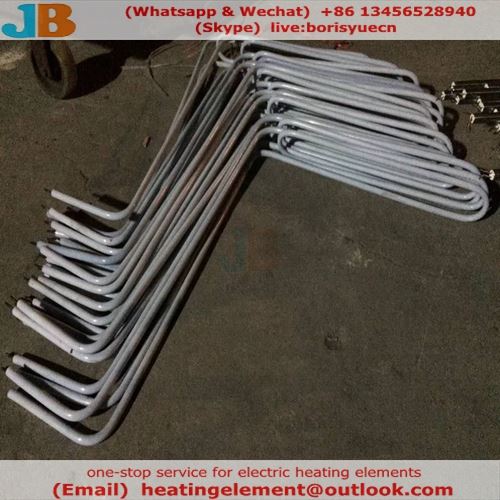
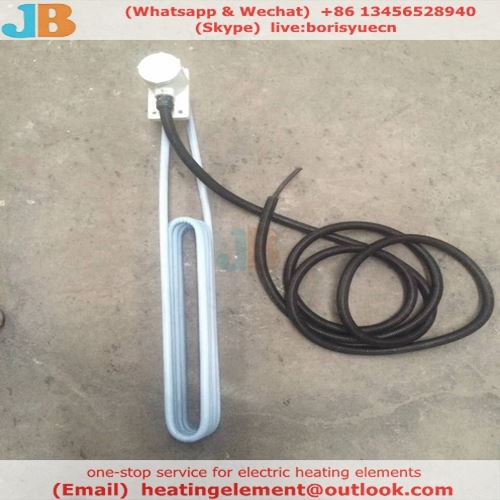
For a seemingly simple heating tube, the difference in production process and material selection will directly affect the work of the heating tube. In the hands of customers, only the external metal pipes and the terminals and accessories of the wiring part are often seen. In fact, the heating tube is a simple electric heating element, its composition is not so simple, and the source of heat is not visible from the outside. The following is a brief introduction to the principle, composition, and accessories of the heating tube.
Heating tube principle: Distribute high temperature resistance wires evenly in the high temperature resistant stainless steel seamless tube, and densely fill the gaps with crystalline magnesium oxide powder with good thermal conductivity and insulation performance. This structure is not only advanced, high thermal efficiency, and uniform heating When there is current passing through the high-temperature resistance wire, the heat generated is diffused to the surface of the metal pipe through the crystalline magnesium oxide powder, and then transferred to the heated part or the air to achieve the purpose of heating.
The structure of the heating pipe mainly includes external metal pipes, high-temperature magnesium oxide powder, heating wires, wiring parts, fasteners, etc.
1. External metal pipe:
In the heating tube processing, the metal pipe is generally processed first, and the outer metal pipe is generally carbon steel, 304 stainless steel, 321 stainless steel, 316 stainless steel, titanium pipe, etc. The external metal pipes are mainly used for protection. Different materials are used to adapt to various use environments. Dry-fired metal pipes are used for dry-fired conditions, high-temperature resistant pipes for high-temperature conditions, and corrosion-resistant pipes for corrosive environments. . Through the protection of the external pipe, the internal heating wire can be used in more environments.
2. High temperature magnesium oxide powder:
Since the inner heating wire has a high resistivity alloy wire, it is a conductor, and current can pass. The outer metal pipe is also a conductor that can pass current. Therefore, in order to insulate the surface of the pipe body, it is necessary to do a good job between the two Insulation treatment, in order to ensure that the heat generated by the internal heating wire can be better conducted to the surface of the pipe, an insulating material with good thermal conductivity is required. The magnesium oxide powder is filled between the heating wire and the metal pipe during the processing of the heating rod. The gap plays a dual role of insulation and heat conduction.
3. Electric heating wire:
The heating source of the heating tube is the internal heating wire that generates heat after passing current. In order to improve the efficiency of electric energy conversion heat energy, alloy wires with high resistance are required, which are processed and formed according to actual needs. Generally, conventional heating wires mainly use alloy wires such as iron-chromium-aluminum, nickel-chromium, and tungsten wires.
4. Other accessories:
In addition to the three main parts mentioned above, the heating tube is also composed of wiring parts, fasteners, and installation parts. The wiring part is conventionally composed of a terminal connected with an internal heating wire; the fasteners are mainly threads or screws. The cap is mainly used for fixing the wiring or the installation of the heating tube. The size is selected according to the size of the tube diameter; the other is the installation accessories. Some heating tubes have baffles or brackets to fix the heating tube installation. The flange heating pipe also has flange related accessories for installation and fixation.
The quality of the heating tube has a direct relationship with the manufacturer, and care must be taken in the selection of the product.