
Among the metal tubular heating tubes used in our industry, although we have a certain understanding of heating tubes, the understanding process may not be comprehensive. How to fully understand every detail of the heating tube industry is for producers and users It is a very good thing. The structure diagram of the metal tubular heating tube is as follows:
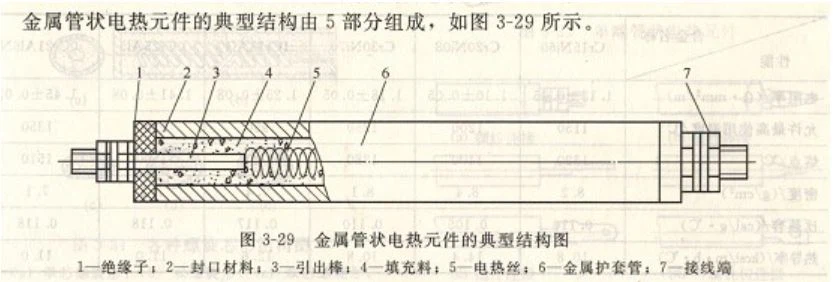
Metal tubular heating pipe structureMetal tubular heating pipe structure
In the figure, the threaded heating wire (marked with symbol 5) and the lead rod (marked with symbol 3) are located in the center of the metal protective sleeve (marked with symbol 6). In the tube, the gap is generally filled with magnesium oxide powder, which is both insulating and thermally conductive. (Many low-quality electric heating tubes produced by low-quality manufacturers use the worst filler-quartz sand). After the filling is installed, the tube is then narrowed with a tube shrinking machine to make the oxide medium compact, ensuring that the heating wire is isolated from the air, and the center position does not shift and touch the tube wall. In this way, the heat per unit area can be increased more than ten times.
Metal tubular heating tube structure: insulator, sealing material, lead rod, filling material, electric heating wire, metal sheath, terminal.
①Insulator: Generally, white porcelain heads are used.
②Sealing material: (mainly understand its function) The sealing material is mainly to make the insulating filling material not easy to absorb the water vapor in the environment, and to ensure that the electric heating tube has good insulation performance. Commonly used sealing materials mainly include: sealing plugs made of paint film, silicone organic paint, epoxy resin, and silicone rubber (we mainly use silicone rubber).
③Extractor rod: Iron is generally used because the heat transfer performance of iron is relatively fast.
④ Filler: Generally there are magnesia powder and quartz sand. We no longer use quartz sand to produce electric heating tubes. The cheap electric heating tubes on the market all contain quartz sand. Our magnesia powders are all modified magnesia powders and electric heating tubes made of modified magnesia powders, which are moisture-proof.
⑤ Electric heating wire: The main ones are iron-chromium-aluminum and nickel-chromium alloy wires. Iron-chromium-aluminum is cheaper, generally without special instructions, iron-chromium-aluminum alloy wires are used in electric heating tubes. Nichrome wire is more expensive. The difference between the two wires: the working temperature of iron-chromium-aluminum alloy materials can reach 1400 ℃, which is enough to meet the needs of electric heating tubes. However, nickel-chromium wire has good flexibility and good oxidation resistance, while iron-chromium-aluminum wire is more brittle.
⑥Metal sheath: mainly stainless steel (SUS201, 304, 321, 316, 310, etc.), copper, carbon steel (iron). Choose different metal sheathing tubes according to different working environments.