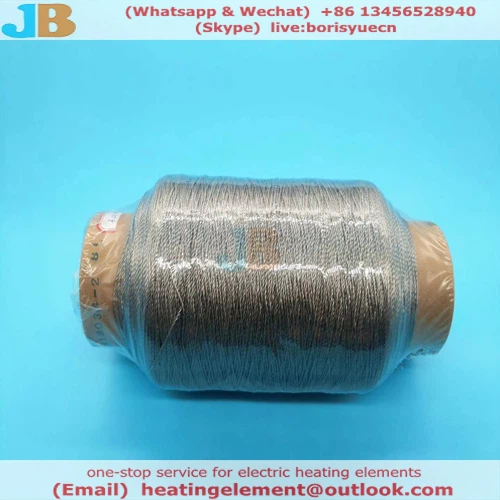
Iron-chromium aluminum, nickel-chromium heating wire its oxidation resistance is generally strong, but because the furnace contains a variety of gases, such as air, carbon atmosphere, sulfur atmosphere and hydrogen, nitrogen atmosphere, etc., these gases have a certain impact on the components under high temperature use, although a variety of electric alloys are oxidation treatment before leaving the factory, but in transportation, winding, installation and other links will cause component damage to a certain extent, and reduce the service life, in order to extend the service life, customers are required to pre-oxidize before use, The method is to heat the installed electric alloy element in dry air to 100-200 degrees lower than the allowable temperature of the alloy, keep warm for 5-10 hours, and then cool slowly with the furnace.
It is understood that the diameter thickness of the heating wire is a parameter related to the use temperature, and the larger the diameter of the heating wire, the easier it is to overcome the deformation problem at high temperature and extend its service life. When the heating wire is operated below the use temperature, the diameter should be kept not less than 3mm, and the thickness of the flat strip should not be less than 2mm. The service life of the heating wire is also largely related to the diameter and thickness of the heating wire. The heating wire is used in a high temperature environment, the surface will form a protective oxide film, the oxide film will age after a period of time, forming a cycle process of continuous generation and destruction, this process is the process of continuous consumption of the internal elements of the electric furnace wire, the diameter and thickness of the electric furnace wire element content more, the service life is longer.
Classify:
Electric alloys: according to the content of chemical elements and the different microstructure, they can be divided into two categories:
One is the iron-chromium-aluminum alloy series, and the other is the nickel-chromium alloy series, which have their own advantages as electric heating materials and are widely used.
Main uses:
Metallurgical machinery, medical, chemical, ceramics, electronics, electrical appliances, glass and other industrial heating equipment and civil heating appliances.