
In many automated factories such as the food industry, electronic products, and retail industries, there are various packaging equipment and packaging machinery. These equipment continue to operate every day to ensure the steady output of factory products.
Before and after loading, the packaging machinery needs to heat the plastic sheet packaging material into a bag through a heating module. The heating module usually uses a strip metal block equipped with an electric heating tube. Quickly close, the plastic packaging material is fused and sealed at the moment it is clamped, and then immediately opened for the next stage of sealing, and so on.
In the process of packaging and plastic sealing, too low or too high temperature will directly affect the packaging effect, so the choice of heating tube is very important. What kind of heating tube is more suitable for packaging machinery? How to ensure that each batch of the same kind of heating tube can meet the requirements? What heating tube should be used for packaging materials with higher sealing requirements? This article will do a brief introduction.
What are the problems with ordinary heating tubes used in packaging opportunities?
Question 1 — The outlet wiring is easily broken.
When the packaging machine is sealing, it can repeatedly open and close about 40-80 times per minute, and the fast type can reach more than 100 times per minute. During the opening and closing process, the heating tube reciprocates at a high frequency along with the sealed metal block. Since then, the wire of the heating tube performs a "single pendulum movement", so the outlet port of the heating tube is often easily damaged, the most common The damage method is disconnection.
The solution to the easy breakage of the outlet wiring-use an internal wiring type heating tube and use a wear-resistant wire. The internal wiring type heating tube has a detailed introduction on the official website of the heat wave, and no additional description is given here.
Question 2 — The heating tube wire is easy to wear.
Same as problem 1, due to repeated high-frequency movement, friction and collision will inevitably occur between the wires and between the wires and the equipment. Over time, problems such as wire skin wear and wire core short-circuit will occur.
The solution to the heating tube wire is easy to wear-use metal braided wire or metal corrugated tube to protect the wire. For heat wave heating tube products, the wire type, wire protection structure, and its length are all customized according to the customer's use.
Problem 3 — The equipment wiring is messy.
Many packaging machines (especially vertical sealing models) work in multiple groups or even more than ten groups of independent packaging units at the same time, so there will be many messy wires. Especially the equipment with narrow outlet space of the heating tube wiring often causes the wire to be excessively bent at the outlet of the heating tube.
The solution to the disorderly arrangement of the equipment — choose an electric heating tube with a right-angle outlet. For equipment with multiple outlets and messy wiring, or when the outlet of the heating tube needs to be bent, use a right-angle electric heating tube, so that the wires of the heating tube can be arranged in the same direction, which helps to optimize the overall wiring method of the equipment.
Question 4 — Uneven sealing temperature
The problem of uneven sealing temperature most often occurs in long strip sealing equipment. Because of its long span and fast heat dissipation at both ends, the temperature in the middle is 10~30℃ higher than the temperature on both sides. It is very sensitive and may cause melting through in the middle or not sealing on both sides.


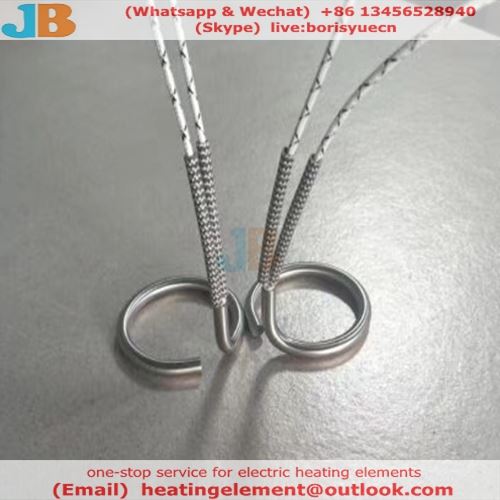
The solution to uneven sealing temperature-uniform temperature electric heating tube. This kind of heating tube has no difference between the appearance of the heating tube and the ordinary heating tube, but the power compensation for the low temperature area is performed on the heating core. This compensation value is obtained after algorithm simulation and software equivalence, and the actual assembly test can be Keep the temperature within ±5°C.